


Insights, benchmarks and recommendations
Value-based B2B proposals: Get the customers to choose you

Content
The report is based on analyses of proposals from Danish B2B companies – and provides 6 recommendations on how to win on value.
Intro
Why is the proposal critical?
Value-based selling does not only lead to higher win rates. It also creates:
- Potentially higher profit margins
- Stronger customer relationships
However, it is not enough for the customer dialogue to be value-based. The proposal itself must be able to stand alone as proof of the value the solution can create.
In reality, it is rarely only the people who participated in the sales meetings who influence the purchasing decision.
Proposals are often read and evaluated by multiple decision-makers who were not part of all the conversations — or in some cases, not even actively engaged during them. For these stakeholders, the proposal becomes the primary point of reference.
When done right, the proposal becomes more than a price list. It becomes a critical document that builds trust, differentiates the company, and increases the likelihood of winning the deal.
This report provides insight into:
- Concrete proposal materials across industries
- Best practices and common pitfalls
- Recommendations on how sales organizations can elevate their proposals to a level where the customer understands the value and is willing to pay for it
The report has been developed in collaboration between Karina Burgdorf Jensen, Associate Professor of Sales, and Intenz.
3 benefits
Win on value – not on price
When sales organizations master value-based proposals, they achieve three clear benefits:
01
Appears professional and customer-focused
02
Establishes a strong foundation and long-term partnerships
03
Reduces the risk of price-based competition
Many B2B proposals and sales presentations focus primarily on product details and price — not on the customer’s business value.
The consequence? The customer perceives the proposal as a cost rather than an investment.
Value-based selling is about shifting the focus from selling products to solving problems and creating results for the customer.
With a value-based approach, the seller becomes an advisor and partner who works with the customer toward shared goals — rather than a traditional salesperson focused on selling a product.
In complex B2B sales, decisions are driven by perceived value — a holistic assessment of the expected benefits weighed against the price.
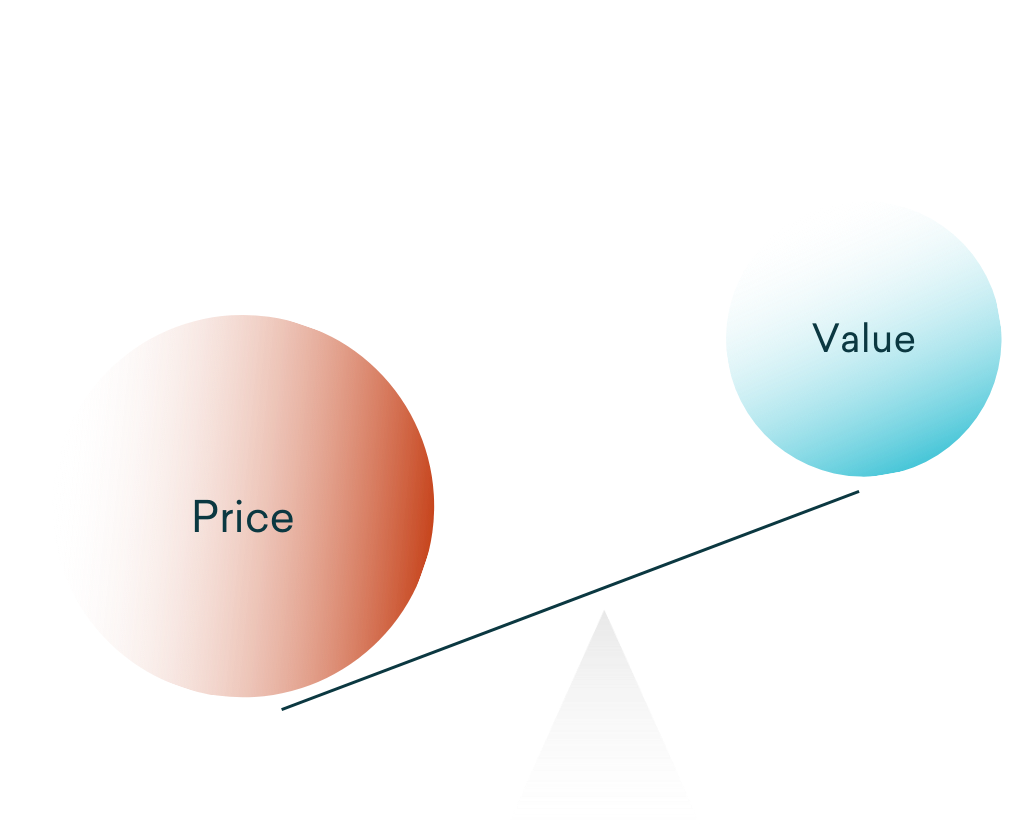
If the seller fails to clearly communicate the concrete benefits and savings for the customer, the proposal risks being evaluated on price alone.
Research shows that a value-based sales focus makes it possible to price based on the customer value delivered rather than on simple cost–benefit calculations. The result is stronger margins and stronger customer relationships.
Nevertheless, value-based selling can be challenging.
Many sales leaders have launched ambitious initiatives where entire sales teams were equipped with value propositions and ROI tools that failed to create meaningful impact — either because they were too complex or because sellers did not use them.
There is a growing need to strengthen value-based proposal development as an integrated part of the sales process rather than treating it as an add-on.

The analysis
Gain insights from how Danish B2B companies approach it
Our findings are based on a broad sample of proposals and contract documents from a range of Danish B2B companies. The materials include everything from standard proposals to collaboration agreements and business cases.
The documents were collected from industries such as IT services, manufacturing, retail, energy, HR, and NGOs. Each document was systematically analyzed based on the core principles of value-based selling.

We assessed all proposals based on the extent to which they:
- Quantify value
Do they include ROI calculations, TCO analyses, or other financial models that clearly demonstrate customer benefits? - Connect to the customer’s business
Is it described which outcomes or improved KPIs the customer can expect? - Support claims with evidence
Does the material use relevant customer cases, references, industry benchmarks, or other proof of value creation? - Address risk and uncertainty
Are the customer’s investment risks addressed — for example through solutions to implementation challenges, guarantees, or risk-sharing mechanisms? - Adapt the message to the customer
Is the content and language tailored to the customer’s context and industry rather than generic sales points?
Based on our criteria, we assigned each case a VBS score (Value-Based Selling score) on a scale from 1 to 5, where 5 represents an almost ideal value-based proposal.
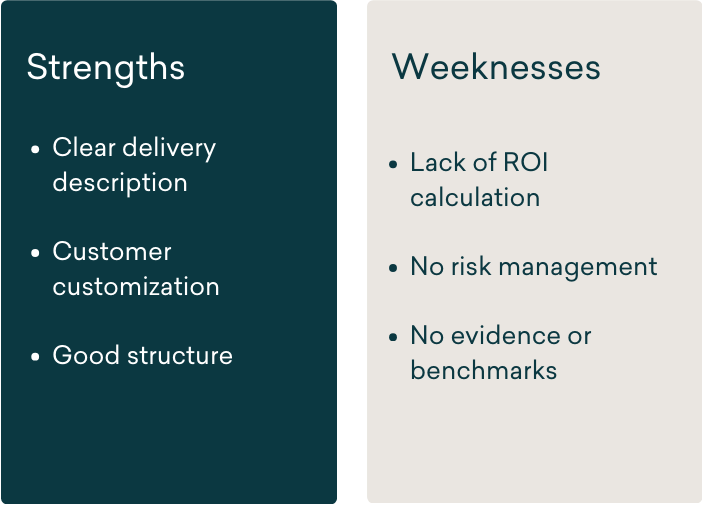
The average score across the material was around the midpoint (2.5), indicating that many proposals only partly meet the criteria for value-based proposals.
Across the material, we identified recurring strengths that many companies already master — as well as recurring weaknesses that continue to challenge their proposal development.
Strengths
Clarity in the delivery and targeted communication
Many documents contained a clear description of the delivery and were linguistically tailored to the recipient. This indicates that companies make an effort to appear professional and responsive to the customer’s situation.
Customer-specific elements
Several proposals highlighted customer-specific elements such as flexible delivery plans, industry-relevant references, or explicit consideration of specific customer needs in the text.
Good structure
A smaller number of proposals made a strong impression by being structured as collaboration agreements and by demonstrating an understanding of the customer’s business roles.
Weaknesses
Lack of value quantification for the customer
Only very few of the documents included an actual ROI calculation, and none contained a full business case calculation. Typically, potential benefits of the solution were mentioned — but without numbers.
Lack of risk analysis
None of the analyzed materials described how the supplier would reduce the customer’s risk. Neither implementation risk, operational disruptions, nor performance guarantees were addressed, even though risk reduction is often critical for customers when purchasing new solutions.
Very limited use of objective data, references, and benchmarks
Only a few proposals (primarily those with higher scores) included small customer cases or referenced industry standards. The majority based their arguments solely on their own product claims without third-party support, which may weaken credibility.
Overall, it is positive that the proposals are clearly customer-focused and that many already reflect the customer’s situation and needs.
Many proposals appeared to be written from an internal perspective (what we deliver) while lacking external proof of value.
Taken together, this paints a picture of companies generally being good at describing what is delivered, but not explaining why it is valuable to the customer.
Proposals rarely included financial arguments or risk-reducing elements, which are at the core of value-based selling. This gap between feature- and price-based selling and value selling is not unusual, but it underscores the need for a more strategic approach to proposal development.
Strategic perspectives
The analysis supports what sales research and experienced consultants have observed: selling on value is difficult in practice.
Many companies launch value-based initiatives, yet sales teams often revert to discount-driven behavior as soon as pressure increases. The ambition to sell on value rather than price cannot be realized without fundamental changes to both sales processes and sales tools.
Our analysis points to the core challenge: even with good intentions to highlight ROI and customer outcomes, many proposals end up reverting to product catalogs with prices.
The core essence of value-based selling is a shift in mindset.
It means moving from asking, “What can I sell to the customer?” to asking, “How can I help the customer achieve their goals?”
This approach requires, first and foremost, a deep understanding of the customer’s business, challenges, and success criteria.
The customer’s perceived value is the relationship between the perceived benefits and the perceived costs of a solution. This fundamentally changes the conversation.
While traditional selling often focuses on product features and a “reasonable price,” value-based selling focuses on the customer’s business outcomes and overall economics.
Several frameworks help explain the different dimensions of value that customers consider. One commonly used model describes value as a pyramid with three levels — from basic product and price expectations at the base to more emotional and strategic values at the top.

The key point is that while customers expect price and quality to be in place, the final decision is largely influenced by the higher levels — particularly risk reduction and credibility.
Communicating value therefore requires both hard facts and emotional reassurance. A solid business case with ROI speaks to financial decision-makers, but it must be complemented by concrete elements that build trust, such as:
- References
- Guarantees
- Service agreements
- Risk sharing
The key is that your message must resonate with the customer’s goals and emotions, stand out from the alternatives, and be supported by evidence.
Our analysis showed that many proposals were particularly lacking the last two elements. They tended to resemble one another and were built on undocumented claims.
The result? Customers end up evaluating the solution based on price.
The right tools and competencies
If you want to succeed in implementing value-based selling across the organization, it requires a structured and deliberate effort.
The transition to value-based selling involves a fundamental shift in both the sales process and sales culture.
Specifically, this requires, among other things:
- Development of new tools for the sales team (such as calculation models, presentations, etc.)
- Training the sales force in the new value messages
- New KPIs and incentives that reward value-driven behavior
Without initiatives like these, a focus on value risks remaining nothing more than well-worded strategy documents, while sales continues as usual.
A key lever is the development of Value Models — concrete models that show how your solution creates value for the customer in practice. These models quantify and structure the value proposition, giving salespeople something tangible to work with.
Without such models, even experienced sales professionals will struggle to articulate value clearly and will often fall back into their comfort zone, where the conversation revolves around features and price.
Recommendations
6 recommendations for value-based proposals
To elevate your proposals to “best-in-class” value-based selling, you should launch the following initiatives:
1. Quantify customer value and develop ROI tools and business cases
Start by putting numbers on the benefits you deliver.
Develop templates or calculation models that can estimate the customer’s ROI from your solution under different assumptions.
This includes:
- Estimated efficiency gains
- Cost savings
- Revenue increases
- A calculation of the payback period
It is important to validate the models with real customer examples to ensure credibility. The goal is for the customer to clearly see: “If we invest X, we will receive approximately Y in return in the form of tangible improvements.”
2. Clearly address the customer’s risks and uncertainties
Make risk reduction a standard part of your proposal structure. Every proposal should include a section that explains how you will ensure a secure implementation and stable operations.
This may include:
- Guarantees (e.g., performance guarantees, uptime guarantees, or outcome guarantees)
- An implementation plan with milestones (demonstrating control over process and timeline)
- Offers of pilot projects or proofs of concept, where relevant
- You may also consider risk sharing — for example, structuring part of the payment to be due only once specific results have been achieved, or assuming part of the risk as the supplier in the event of delays.
Customers highly value a supplier’s ability to reduce risk. By proactively addressing risks and clearly describing your initiatives, you signal professionalism and an understanding of the customer’s situation — which builds trust.
A simple rule of thumb: put yourself in the customer’s position and ask, “What concerns might make them hesitant to choose us?”
3. Substantiate the value promise with concrete cases, data, and benchmarks
To substantiate your value messages, you must include evidence that the promised value can actually be realized.
This can be done by including short customer case descriptions with results, for example:
“Customer A achieved a 20% cost reduction by implementing this solution.”
Use charts or tables to illustrate before-and-after states where possible. If you have reference customers similar to the prospect, obtain permission to reference their results or quote them in a testimonial.
If internal cases are not available, industry benchmarks can be used instead, for example: “According to XX, companies in your industry typically achieve 10–15% productivity improvements by digitizing this process.”
The objective is to give the customer something tangible to rely on. Therefore, include concrete KPIs that show how the customer can measure the value themselves.
By quantifying results, you create a shared target picture with the customer. Value-based selling is about documenting and proving value. The more evidence you provide, the less risk the customer has to take.
4. Tailor the proposal to all decision-makers
A proposal is rarely read by just one person. Typically, users, technical specialists, line managers, finance, and senior leadership are all involved in the decision. Your proposal should therefore include relevant messages for each of these groups.
This means highlighting operational benefits and technical details sufficiently to satisfy user and technical stakeholders, while clearly presenting the financial and strategic benefits to C-level decision-makers.
A good approach is to open with a ‘Management summary’ — a short, non-technical page summarizing ROI, strategic fit, and risk management. This can then be followed by a technical appendix that goes deeper into product details and integration options for specialists.
In short: differentiate your communication within the same document. Structurally, this can be done by including sections that address different agendas. For example, a CFO may focus on cost analysis, while the IT department will look for technical solution architecture.
Different decision-makers value different things. Therefore, visualize the customer’s decision-making unit: who influences the decision? Ensure that each stakeholder finds something in the proposal that makes them say “yes”.
5. Strengthen sales team competencies and incentives around value-based selling
No process or template can do it alone. It is people who must carry the value message all the way through.
That is why you should invest in upskilling your sales organization in consultative dialogues, including:
- Asking the right questions to uncover the customer’s true needs and pain points
- Listening actively to identify the underlying value the customer is seeking
Provide training in the financial aspects of selling as well. Not all sellers are comfortable with financials, so help them become confident in walking through an ROI calculation with the customer and defending it.
Competencies must be supported by the right incentives and KPIs. If success is measured solely on revenue and discounts, value-based behavior will slowly be suffocated. Introduce new metrics for proposal quality — for example, the share of proposals that include ROI calculations or customer feedback on value understanding. Also reward sellers who win on value rather than price.
Finally, the principles of value-based selling should be reflected in CRM systems and sales stages, ensuring that the desired behaviors are embedded in day-to-day work.
Cultural change takes time, but if leadership clearly signals that value-based selling is a priority, the team will gradually adapt.
6. Follow up on delivered value and learn from the results
Value-based selling does not end with the contract signing. It should extend beyond delivery to maintain credibility and build references.
Ensure that you measure the actual results achieved by the customer and compare them with what was presented in the proposal. If you promised a 15% efficiency improvement, what was the reality after 6–12 months?
Hold an evaluation discussion with the customer where you document both the successes and any deviations.
Following up on delivered value sends a strong signal to the customer: you are not only interested in the sale — you are committed to the customer’s success.
That is the essence of value-based partnership.
Summary and conclusion
Value-based selling and proposal development is a discipline that combines analysis, empathy, and communication.
Even high-performing sales organizations have blind spots when it comes to proving value, but the analysis shows that relatively simple initiatives can make a significant difference.
You can transform your proposals from being “one of many” into strategic documents that differentiate you and build trust. This requires that you:
- Quantify value
- Address risk
- Support claims with evidence
- Speak to all stakeholders
- Build the right internal competencies
The goal is to make it easy for the customer to say yes — because they can clearly see how your solution contributes to their business, and because they trust that you will deliver the promised value.